The Quilt Block’s Journey from Pattern to Family Record
Trace a quilt block from repeated pattern to family record, separating what its fabric and construction document from the meanings relatives later attach.
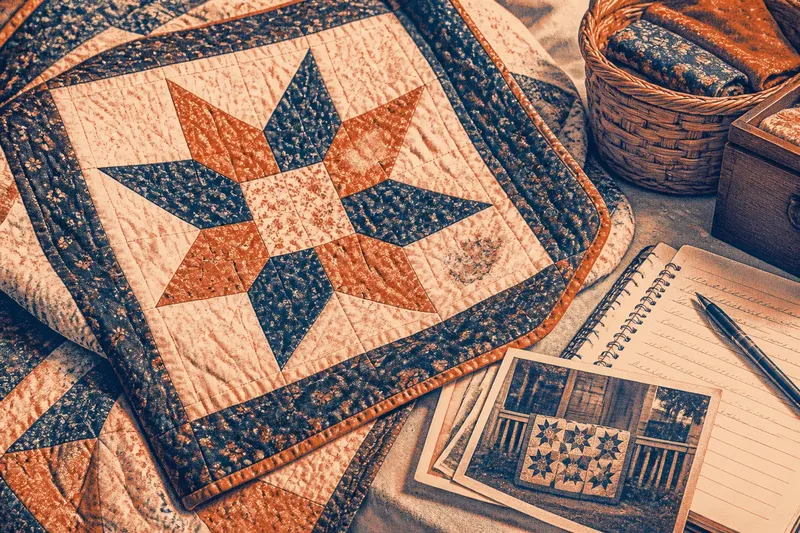
A familiar quilt block sits on a bed, its points slightly uneven and one patch faded where sunlight reached it. Someone in the family calls it a wedding quilt; another remembers it hanging in a spare room. To read a quilt block as a family record, begin with what its materials and construction show, then keep inherited explanations distinct from details you can inspect.
Start by separating the cloth from the story
A repeated block can carry several kinds of information at once. Its shape may belong to a pattern shared among many makers, while the fabrics, wear and stitching offer clues about this particular quilt. A family account may add a name or occasion, but that account is not automatically confirmed by the object.
Make two notes before trying to identify anything: one for visible evidence and one for remembered information. Record observations such as a printed cotton, a hand-sewn seam, a replaced patch or a name written on the back. Put claims about who made it, why it was made or what a block “means” in the second note, with the speaker and the wording if known.
This separation is not a way to discount family knowledge. It lets you preserve a relative’s account accurately without turning an interpretation into a fact about the quilt’s origin.
Recognise a pattern without treating it as a signature
Quilt-block names help people describe designs, compare examples and look up construction methods. A named pattern is not, by itself, proof that a quilt came from one region, belonged to one community or marked a particular event. Similar arrangements of squares, triangles and strips can circulate through printed patterns, teaching, household practice and personal adaptation.
Start with the geometry. Notice whether the block is built from squares, half-square triangles, strips or a central shape, and whether the same units repeat in the same orientation. Then look for changes: a corner turned, a colour swapped, a border added or one block set against a contrasting neighbour. Those choices may show how a maker worked with a pattern, but they do not reveal a motive on their own.
Say you inherit a quilt with a repeated star-shaped block and your aunt recalls that it belonged to her grandmother. You can describe the recurring shape, note that your aunt supplied the family link, and ask whether anyone remembers the maker’s name. Until further evidence turns up, the design is an observed pattern and the family link is an attributed account, not a confirmed date or occasion.
Read construction as evidence of making
Examine the quilt as a made object rather than as a coded message. Look at how blocks join, whether seams are hand-stitched or machine-stitched, how the top is attached to the batting and backing, and whether the quilting lines follow the block shapes or cross them. These features can help describe the work and identify repairs or changes.
Keep conclusions proportionate. A hand-sewn seam shows hand sewing; it does not establish who did it. A machine-stitched section may belong to the original assembly or to a later repair. A mix of methods can reflect more than one stage of a quilt’s life, so note where each method appears instead of assigning the whole object a single story.
Look closely at wear, but do not read it as a calendar. A faded patch suggests exposure to light; a softened edge suggests handling or use. Neither tells you exactly when, where or by whom that use happened. Photograph details in even light and include the front, back, edges, seams and any labels, without pulling at loose threads.
Check fabric, labels and repairs before dating the quilt
Fabric can narrow questions, but a print alone rarely settles them. Compare several patches and notice whether they differ in weave, colour, pattern scale or condition. A quilt may combine cloth saved from different garments or household projects, and a later repair may introduce fabric that looks unlike the rest.
Search for a label, inscription, maker’s mark or written note, and record its location and exact wording. A name on a label is useful evidence that someone associated that name with the quilt; it may not tell you whether that person pieced, quilted, owned or later labelled it. Preserve the distinction in your notes.
If a date matters, look for support beyond a block’s popular name. A dated inscription, a family photograph showing the quilt, or a consistent account from people who knew its history may help establish context. Where the evidence remains uncertain, describe a range of possibilities in plain language rather than assigning a precise date. For fragile textiles or uncertain care, follow the maker’s or conservator’s guidance and seek a textile conservator when needed.
Why do quilt blocks acquire family meanings?
Does a block name prove where a quilt was made?
No. A pattern name is a way to identify a design, not a certificate of place. Record the name as a pattern identification and use separate evidence for any claim about where the quilt was made.
Can a family story be kept if it is unverified?
Yes. Preserve who told the story, what they said and how they knew it, if that is remembered. Mark it as family testimony rather than presenting it as a documented fact.
What does a repair reveal about a quilt’s history?
A repair shows that someone altered or cared for the object, and its material may distinguish it from surrounding cloth. Without a label, account or other supporting evidence, the repair does not identify the person or date.
How should an uncertain maker be described?
Use wording that keeps the uncertainty visible, such as “maker unknown” or “family tradition attributes the quilt to…” Add the source of that attribution when you can, rather than silently converting it into a firm claim.
Keep a record that relatives can build on
Write a short object description that someone outside the family could understand. Include the quilt’s current owner or location if appropriate, its visible construction, notable materials, inscriptions, repairs and the source of each family account. Avoid writing a single confident narrative when the evidence supports several possibilities.
- Photograph the full quilt and close views of distinctive blocks, labels and repairs.
- Describe the block arrangement in ordinary terms before adding a pattern name.
- Record remembered stories with the teller’s name and the occasion when the account was shared.
- Separate direct observations, written evidence and oral accounts in your notes.
- Keep copies of photographs, letters or captions that connect the quilt to a person or household.
When relatives disagree, preserve both versions with their sources. One person may remember a quilt being made for a marriage; another may remember it arriving later from a different household. The disagreement is part of the record, and it may point to questions worth asking without requiring you to choose a version prematurely.
Let the quilt remain more than one kind of record
A quilt block can be a repeatable design, a piece of practical sewing and a marker of family attachment at the same time. Its geometry belongs to a broader language of pattern; its cloth and construction belong to the object; its remembered meaning belongs to the people who have carried its story.
For a useful family record, keep those layers together without blending them. A clear description of what you can see, paired with carefully attributed memories, lets the quilt’s pattern and its family meaning remain visible—and leaves room for the next relative to add evidence or a story of their own.